
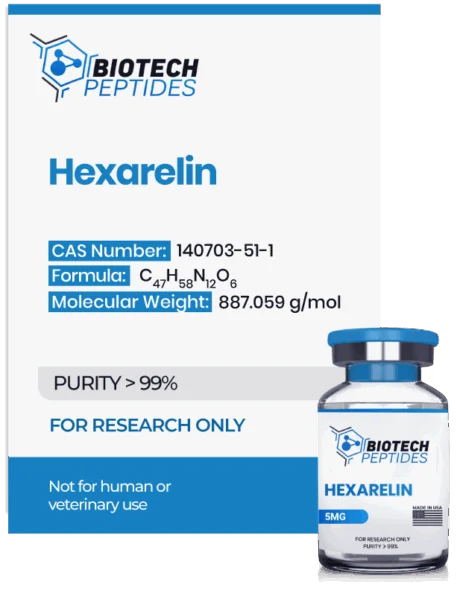
Hexarelin (5mg)
$49.00
Buy Hexarelin: A Comprehensive Research Guide
The decision to buy hexarelin has become increasingly common among researchers investigating growth hormone regulation, cardiovascular protection, and neuroendocrine signaling. Hexarelin is a synthetic hexapeptide belonging to the class of growth hormone secretagogues (GHS), designed to stimulate the release of growth hormone from the pituitary gland. This comprehensive guide provides researchers with essential information for those looking to buy hexarelin, covering its chemical properties, mechanism of action, research applications, quality considerations, and regulatory status.
Understanding Hexarelin
Hexarelin, also known as Examorelin, is a synthetic hexapeptide consisting of six amino acids with the sequence His-D-2-methyl-Trp-Ala-Trp-D-Phe-Lys-NH2. The chemical properties of hexarelin include a molecular formula of C₄₇H₅₈N₁₂O₆ and a molecular weight of approximately 887.04 g/mol. Its CAS number is 140703-51-1. The peptide is characterized by a substituted 2-methyl-tryptophan residue, which provides better stability than related compounds like GHRP-6.
Hexarelin is typically supplied as a lyophilized white powder with purity specifications of at least 98% to 99% when analyzed by high-performance liquid chromatography. Proper storage of hexarelin at -20°C in a dry, desiccated environment protected from light is essential for maintaining peptide integrity. The peptide is soluble in sterile water or bacteriostatic water for reconstitution, and researchers should prepare aliquots to avoid repeated freeze-thaw cycles.
Mechanism of Action buy hexarelin
Growth Hormone Secretagogue Receptor Activation
exerts its primary effects by binding to and activating the growth hormone secretagogue receptor (GHS-R1a) in the hypothalamus and pituitary gland. This receptor is also the target of the natural hormone ghrelin. Upon binding, hexarelin stimulates the release of growth hormone from the anterior pituitary in a pulsatile manner, mimicking the body’s natural GH secretion pattern.
The potency of hexarelin at the GHS-R1a receptor is comparable to that of ghrelin, with a half-maximal effective concentration of approximately 1.7 nmol/L. This makes hexarelin a highly effective tool for studying growth hormone regulation in research settings.
Distinct Cardiac Receptor Binding buy hexarelin
Unlike ghrelin, hexarelin can also bind to a distinct receptor subtype in cardiac and peripheral tissues. The peptide binds to a receptor that is similar to the GHS-R1a but is not identical. This binding site appears to be involved in the cardiovascular effects of hexarelin, including the protection of cardiac cells from various forms of injury.
GH-Independent Effects
Research has identified various GH-independent effects of hexarelin, including cardioprotection . Hexarelin has been shown to protect isolated rat hearts from ischemia-reperfusion injury in a dose-dependent manner through mechanisms that may involve the CD36 receptor . These GH-independent effects make hexarelin a compound of particular interest for researchers studying cardiovascular protection and tissue repair.
Research Applications buy hexarelin
Growth Hormone Regulation Studies
Hexarelin is widely used in growth hormone research. The peptide’s ability to stimulate GH release through the GHS-R1a receptor makes it a valuable tool for investigating the regulation of the somatotropic axis. Researchers use hexarelin to study the effects of various factors on GH secretion, including the influence of nutritional status, metabolic signals, and other hormonal factors.
Studies have explored the effects of hexarelin on GH release in various experimental models, contributing to understanding the complex regulation of growth hormone secretion. The peptide’s ability to stimulate GH release in a pulsatile manner, mimicking the natural pattern of GH secretion, makes it particularly useful for these studies.
Cardiovascular Research
Hexarelin has been extensively studied for its potential cardioprotective effects. Research has demonstrated that hexarelin can protect cardiac cells from various forms of injury, including ischemia-reperfusion injury and oxidative stress . The peptide’s ability to bind to distinct cardiac receptors appears to mediate these cardioprotective effects.
Studies have explored the mechanisms underlying hexarelin’s cardioprotective effects. Research has investigated how hexarelin influences cardiac function, including its effects on cardiac contractility, coronary flow, and protection against ischemic injury . These studies have contributed to understanding the role of growth hormone secretagogues in cardiovascular health.
Neuroendocrine Research
Hexarelin has been studied for its effects on the neuroendocrine system. The peptide’s ability to stimulate GH release through the hypothalamus and pituitary makes it a valuable tool for investigating the neuroendocrine regulation of growth hormone secretion. Researchers have used hexarelin to study the interactions between various neuroendocrine systems and the somatotropic axis.
Studies have explored the effects of hexarelin on neurotransmitter systems, neuroendocrine feedback mechanisms, and the integration of metabolic and reproductive signals with growth hormone regulation. These investigations contribute to understanding the complex neural networks that regulate growth hormone secretion.
Metabolic Research
Hexarelin has been investigated for its potential effects on metabolism. The peptide’s ability to stimulate GH release can influence various metabolic processes, including lipid metabolism, glucose homeostasis, and protein synthesis. Researchers studying the metabolic effects of GH stimulation may find hexarelin a valuable tool for their investigations.
Studies have explored how hexarelin influences metabolic parameters, including insulin sensitivity, glucose tolerance, and lipid profiles. These investigations contribute to understanding the relationship between growth hormone regulation and metabolic health.
Quality Considerations When You Buy Hexarelin
Purity Standards
For those looking to for research purposes, quality standards are essential. Research-grade hexarelin should demonstrate minimum purity specifications of at least 98% when analyzed by high-performance liquid chromatography. Many suppliers require a minimum 98% to 99% purity specification enforced at the batch level, with release contingent on verified analytical conformance. High-purity research peptides are critical for experimental reproducibility, as impurities from synthesis can confound experimental results.
Analytical Verification
When you buy hexarelin, ensure the supplier provides comprehensive analytical documentation. The certificate of analysis should include identity confirmation by mass spectrometry, purity by HPLC, sequence confirmation, and appearance testing. Additional testing may include residual solvent analysis, water content, acetate content, peptide content, endotoxin testing, and microbial limit testing.
Documentation Requirements
Legitimate suppliers from whom you buy hexarelin should offer batch-specific Certificates of Analysis containing HPLC chromatograms and mass spectrometry identity confirmation. Third-party lab accreditation and pre-purchase document access are indicators of reliable sourcing. Researchers should verify that these documents are available before completing any transaction.
Storage and Handling
Hexarelin is typically supplied as a lyophilized powder, which helps preserve peptide stability during storage and transportation. Researchers who buy hexarelin should store lyophilized peptide at -20°C in a dry, desiccated environment protected from light. Upon reconstitution, the peptide should be stored at 4°C and used within a short timeframe to prevent loss of potency.
Repeated freeze-thaw cycles should be avoided to maintain peptide stability. Preparing aliquots of reconstituted hexarelin for single-use applications preserves compound integrity over extended research periods. Proper handling protocols ensure that experimental results reflect genuine biological phenomena rather than artifacts of degraded research materials.
Regulatory Status and Legal Considerations
Hexarelin is classified as a research-use-only product for laboratory investigations. These compounds are not approved for human use outside of clinical trials and are intended exclusively for in-vitro laboratory research. Researchers who buy hexarelin must ensure compliance with all applicable regulations regarding the acquisition, handling, and use of research peptides in their jurisdiction.
The regulatory landscape for research peptides continues to evolve. Hexarelin is not FDA-approved for any clinical indication and is available only for research purposes. Researchers should maintain awareness of regulatory changes that may affect the acquisition and use of research peptides.
Conclusion buy hexarelin
Hexarelin represents a significant peptide of research interest across multiple scientific disciplines, from growth hormone regulation and cardiovascular research to neuroendocrine and metabolic studies. Its unique mechanism of action, involving both GH-dependent and GH-independent effects, positions hexarelin as a valuable research tool for investigating growth hormone biology and cardiovascular protection.
For researchers looking to buy hexarelin, understanding the compound’s chemical properties, quality requirements, and research applications is essential. High-purity research-grade hexarelin, stored and handled properly, provides a valuable tool for investigating fundamental biological processes. When evaluating suppliers from whom to buy hexarelin, researchers should prioritize those that provide comprehensive quality documentation, including HPLC purity verification and mass spectrometry confirmation, to ensure experimental reproducibility and scientific validity.
The research applications of hexarelin continue to expand as understanding of growth hormone biology and cardiovascular protection deepens. From growth hormone regulation to cardioprotection and neuroendocrine research, hexarelin remains a compound of significant interest for researchers committed to scientific discovery. However, researchers should maintain awareness of the regulatory status and ensure compliance with all applicable regulations regarding the acquisition, handling, and use of research peptides in their jurisdiction.
Related products
BIOTECH PEPTIDE
BIOTECH PEPTIDE
BIOTECH PEPTIDE
BIOTECH PEPTIDE
BIOTECH PEPTIDE
BIOTECH PEPTIDE
BIOTECH PEPTIDE
BIOTECH PEPTIDE