
N-Acetyl Selank (10mg)
$50.00
n acetyl selank, n-acetyl selank, n-acetyl selank amidate, n acetyl selank amidate, n-acetyl selank nootropicology,
n acetyl selank amidate acetate, n acetyl selank benefits nootropicology, n-acetyl-selank, n-acetyl-selank-amidate acetate,buy n-acetyl-selank amidate for sale, n acetyl selank amidate dosage, n acetyl selank spray,
N-Acetyl Selank: A Comprehensive Research Guide
N-acetyl selank has emerged as a significant compound of interest in neurobiological and immunological research. N-acetyl selank is a synthetic derivative of the heptapeptide Selank, which itself is a structural analog of the endogenous immunomodulatory tetrapeptide tuftsin. The acetylation of Selank involves the addition of an acetyl group to the N-terminus of the peptide sequence, a modification designed to enhance metabolic stability and potentially modify receptor interactions. This comprehensive guide provides researchers with essential information about N-acetyl selank, including its chemical properties, mechanism of action, research applications, and quality considerations.
Understanding N-Acetyl Selank
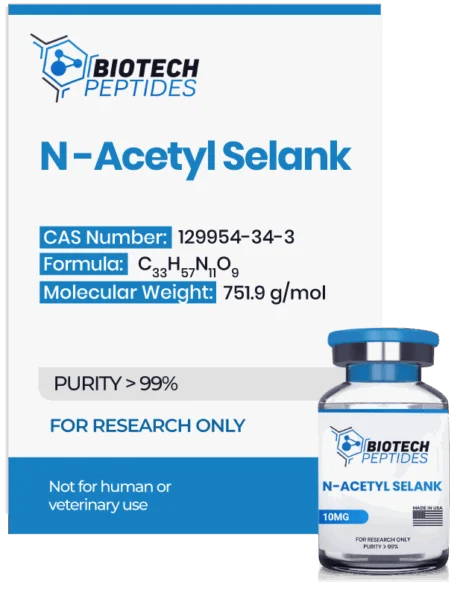
N-acetyl selank is a synthetic peptide belonging to the class of heptapeptide analogs, structurally related to the endogenous tetrapeptide tuftsin. The peptide sequence is Ac-Thr-Lys-Pro-Arg-Pro-Gly-Pro-OH, with a molecular formula of C₃₃H₅₇N₁₁O₉ and a molecular weight of approximately 751.89 Da. The acetylation adds a modest increase in lipophilicity at the terminus, which may influence membrane interactions or receptor access in research models.
N-acetyl selank was developed as a modified version of Selank, which was originally designed to be a synthetic analog of the human tetrapeptide tuftsin and classified as a nootropic, anxiolytic peptide. The acetylated form enhances metabolic stability, making it particularly valuable for biochemical studies involving neuropeptide function and peptide-receptor interactions. The modifications to N-acetyl selank are believed to protect the N-terminal group from breakdown and increase the stability of the peptide. This structural tweak is thought to confer extended half-life or altered receptor engagement relative to non-acetylated Selank.
N-acetyl selank is typically supplied as a lyophilized powder with purity specifications of at least 98% when analyzed by high-performance liquid chromatography. Proper storage of N-acetyl selank at -20°C in a dry, desiccated environment protected from light is essential for maintaining peptide integrity. Upon reconstitution, the peptide should be stored at 4°C and used within a short timeframe to prevent loss of potency.
Mechanism of Action N-acetyl selank
GABAergic System Modulation
One of the better characterized modes of action for Selank, and by extension N-acetyl selank, is its modulation of the GABAergic system. Research suggests that Selank may alter the binding properties of gamma-aminobutyric acid (GABA) to its receptors, perhaps via allosteric modulation, and thereby influence inhibitory neurotransmission. In neuronal preparations, Selank has been associated with a shift in specific GABA binding without necessarily altering affinity, indicating modulation of receptor state rather than direct agonism.
By analogy, N-acetyl selank seems to retain or even tune such modulatory potential. The acetylation may change the binding kinetics or bias the peptide toward particular receptor subtypes. In research models of GABA receptor dynamics, N-acetyl selank might be studied to probe subunit-specific modulation or to explore how peptide-based modulators influence receptor plasticity over time.
Monoamine and Serotonergic Systems N-acetyl selank
Studies suggest that Selank has been implicated in modulating monoamine neurotransmitter concentrations, including serotonin metabolism and turnover. There is a suggestion that Selank may upregulate serotonin metabolism or availability in brain regions. It is thus plausible that N-acetyl selank might influence serotonergic signaling more persistently or with different temporal profiles.
In experimental settings concerning serotonin transporters, receptor binding assays, or gene expression of serotonergic pathway components, N-acetyl selank has been hypothesized to serve as a tool to perturb the equilibrium of serotonin metabolism. Researchers might employ it to examine feedback loops in serotonergic neurons, or to assess how serotonergic tone affects downstream gene networks or synaptic plasticity.
Enkephalin and Endogenous Peptide Research N-acetyl selank
Selank has been reported to inhibit peptide-degrading enzymes (such as enkephalinases), thereby elevating endogenous regulatory peptides like enkephalins. If N-acetyl selank preserves or enhances such inhibitory capacity, it could serve as a modulator of endogenous peptide signaling systems.
In research contexts focused on neuropeptide regulation, enkephalin turnover, or peptidase assays, N-acetyl selank may act as a chemical tool to transiently suppress peptidase activity, thereby elevating levels of endorphins or enkephalins for mechanistic study. Moreover, by comparing non-acetylated Selank and N-acetyl selank, investigators might delineate how acetylation impacts peptidase binding or inhibitory potency.
Engagement with Neurotrophic Pathways
Selank has been associated with the rapid upregulation of brain-derived neurotrophic factor (BDNF) in hippocampal tissue in research models. Because BDNF is central to synaptic plasticity, neurogenesis, and neuronal remodeling, any modulator of BDNF is of interest in neuroscience research.
It is plausible that N-acetyl selank might induce a more sustained elevation of BDNF expression or influence downstream TrkB signaling in distinct time windows, owing to enhanced stability. Research indicates that in models of synaptic plasticity, long-term potentiation (LTP), or neurogenesis, N-acetyl selank may be used to probe the coupling between peptide signaling and trophic growth factor cascades.
Immune and Cytokine Modulation Research
Beyond neuroscience, Selank is connected with immunomodulation, including altering the expression of cytokines such as interleukin-6 (IL-6) and influencing the balance among T helper cell cytokines. As a tuftsin analogue, Selank’s immunoregulatory profile is a notable feature.
Investigations purport that the N-acetylated derivative might preserve such immunoregulatory capacity, potentially enhancing peptide stability in immunological assays. It has been theorized that in immune cell culture models or cytokine profiling experiments, N-acetyl selank could be applied to examine the intersection between neuropeptide signaling and immune effector function.
Research Applications
Anxiety and Stress Research
N-acetyl selank has been investigated for its potential anxiolytic properties. Research has demonstrated that Selank can reduce anxiety-like behaviors in various animal models. Studies have explored how Selank influences stress responses, anxiety-related behaviors, and neuroendocrine function.
The peptide’s effects on the GABAergic system and monoamine neurotransmitters suggest that N-acetyl selank may have applications in research into anxiety disorders and stress-related conditions. Researchers have investigated how N-acetyl selank compares to traditional anxiolytics and how it may modulate stress responses through multiple mechanisms.
Cognitive Function Research
N-acetyl selank has been studied for its potential effects on cognitive function. Research suggests that Selank may influence learning, memory, and cognitive performance. Studies have explored how the peptide affects neurotransmitter systems involved in cognitive function and how it may modulate cognitive processes.
Researchers have investigated the effects of Selank on attention, memory consolidation, and cognitive flexibility in various experimental models. The peptide’s potential cognitive-enhancing properties, combined with its anxiolytic effects, position N-acetyl selank as a compound of interest for researchers studying the intersection of anxiety and cognitive function.
Immunomodulation Research
N-acetyl selank has been investigated for its immunomodulatory properties. Research has demonstrated that Selank can influence immune function through multiple mechanisms. Studies have explored how Selank affects cytokine production, immune cell activity, and antiviral responses.
The peptide’s immunomodulatory properties suggest that N-acetyl selank may have applications in research into immune regulation and inflammatory conditions. Researchers have investigated how N-acetyl selank influences the immune response and how it may modulate immune function in various contexts.
Neuroprotection Research
N-acetyl selank has been investigated for its potential neuroprotective properties. Research suggests that Selank may protect neurons from various forms of stress and injury. Studies have explored how Selank influences oxidative stress markers, cellular protection mechanisms, and neuronal survival.
The peptide’s effects on the GABAergic system, neurotrophic pathways, and its immunomodulatory properties may contribute to its neuroprotective effects. Researchers have investigated how N acetyl selank modulates neuroinflammatory responses and supports neuronal health.
Quality Considerations for Research Peptides N-acetyl selank
Purity Standards
For those acquiring N-acetyl selank for research purposes, quality standards are essential. Research-grade N-acetyl selank should demonstrate minimum purity specifications of at least 98% when analyzed by high-performance liquid chromatography. Many suppliers require a minimum 98% to 99% purity specification enforced at the batch level, with release contingent on verified analytical conformance. High-purity research peptides are critical for experimental reproducibility, as impurities from synthesis can confound experimental results.
Analytical Verification
When acquiring N-acetyl selank, researchers should ensure the supplier provides comprehensive analytical documentation. The certificate of analysis should include identity confirmation by mass spectrometry, purity by HPLC, sequence confirmation, and appearance testing. Additional testing may include residual solvent analysis, water content, acetate content, peptide content, endotoxin testing, and microbial limit testing.
Documentation Requirements
Legitimate suppliers should offer batch-specific Certificates of Analysis containing HPLC chromatograms and mass spectrometry identity confirmation. Third-party lab accreditation and pre-purchase document access are indicators of reliable sourcing. Researchers should verify that these documents are available before completing any transaction.
Storage and Handling
N acetyl selank is typically supplied as a lyophilized powder, which helps preserve peptide stability during storage and transportation. Researchers should store lyophilized N acetyl selank at -20°C in a dry, desiccated environment protected from light. Upon reconstitution, the peptide should be stored at 4°C and used within a short timeframe to prevent loss of potency.
Regulatory Status and Legal Considerations
N acetyl selank is classified as a research-use-only product for laboratory investigations. These compounds are not approved for human use outside of clinical trials and are intended exclusively for in-vitro laboratory research. Researchers must ensure compliance with all applicable regulations regarding the acquisition, handling, and use of research peptides in their jurisdiction.
Conclusion
N-acetyl selank represents a compound of significant research interest across multiple scientific disciplines, from neurobiology and anxiety research to immunology and neuroprotection studies. The peptide’s unique mechanism of action, involving modulation of the GABAergic system, monoamine neurotransmitters, and immunomodulatory effects, distinguishes it from other compounds and positions it as a valuable research tool for investigating the intersection of neurobiology and immunology.
For researchers acquiring N acetyl selank, understanding the compound’s chemical properties, quality requirements, and research applications is essential. High-purity research-grade N acetyl selank, stored and handled properly, provides a valuable tool for investigating fundamental biological processes. When evaluating suppliers, researchers should prioritize those that provide comprehensive quality documentation, including HPLC purity verification and mass spectrometry confirmation, to ensure experimental reproducibility and scientific validity.
The research applications of Nacetyl selank continue to expand as understanding of its mechanisms and potential applications deepens. From anxiety and stress research to cognitive function, immunomodulation, and neuroprotection, N acetyl selank remains a compound of significant interest for researchers committed to scientific discovery. As the field of peptide research advances, N acetyl selank will undoubtedly continue to contribute to our understanding of fundamental biological processes and potential research applications.
Related products
BIOTECH PEPTIDE
BIOTECH PEPTIDE

BIOTECH PEPTIDE
BIOTECH PEPTIDE

BIOTECH PEPTIDE
BIOTECH PEPTIDE
BIOTECH PEPTIDE
BIOTECH PEPTIDE