
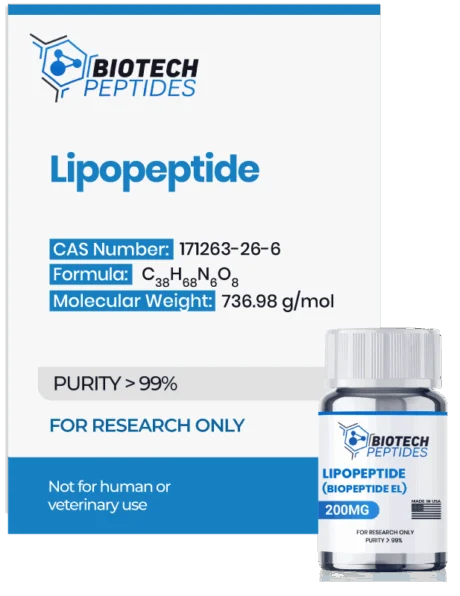
Lipopeptide (Biopeptide EL) (200mg)

$180.00
Buy Lipopeptide research grade. High purity antimicrobial compound. Bulk discounts available. Fast shipping. Secure checkout. Order now.
Lipopeptide: Comprehensive Guide to Structure, Applications, and Research
Introduction to Lipopeptides
Lipopeptides represent a remarkable class of amphiphilic molecules that combine the structural features of lipids and peptides. These compounds consist of a short peptide chain conjugated with an acyl chain, typically ranging from C12 to C18 in length . The unique combination of hydrophilic peptide headgroups and hydrophobic lipid tails gives lipopeptides exceptional surface-active properties and diverse biological activities that have captured the attention of researchers across multiple scientific disciplines.
The fundamental architecture of a lipopeptide involves the attachment of a fatty acyl chain to the N-terminus of either a cyclic or linear short polypeptide, typically comprising between 4 and 12 amino acids . This structural arrangement results in low-molecular-mass compounds, generally ranging from 500 to 1500 Daltons, that exhibit “membrane-active” amphiphilic properties due to having both a hydrophilic head and a hydrophobic tail .
Lipopeptides are naturally produced on the surfaces of microbial cells and are secreted extracellularly, commonly referred to as “microbial surfactants” . They are considered secondary metabolites produced by numerous fungi, yeasts, and bacteria, with Bacillus and Pseudomonas species being particularly prolific producers .
Structural Classification of Lipopeptides
Understanding the structural diversity of lipopeptides is essential for appreciating their wide range of biological activities and research applications. Lipopeptides can be classified based on several criteria, including chemical structure, source, production mechanism, or net charge.
Linear Lipopeptides
Linear lipopeptides typically have the fatty acyl chain connected to either the α-amino group or other hydroxyl groups of the peptide. Examples include cerexins, tridecaptins, corrugatins, and syringafactins, which have been isolated from Paenibacillus spp., Bacillus spp., and Pseudomonas spp. . While these compounds are easier to produce and purify than their cyclic counterparts, research on this group remains relatively limited .
Cyclic Lipopeptides
Cyclic lipopeptides represent the most extensively studied class and are characterized by a cyclic lactone or lactam ring of amino acid residues linked to a lipophilic moiety. These molecules often involve complex mixtures of D- and L-amino acids and non-proteinogenic residues . The cyclization of lipopeptides stabilizes their structure and is often required to enable interaction with biological targets, which explains why the activity of linear lipopeptides typically does not match that of their cyclic counterparts .
The most studied cyclic lipopeptides include viscosins, surfactins, iturins, fengycins, amphisins, lichenysins, and putisolvins . Cyclization enhances in vivo stability by reducing proteolysis resulting from the absence of free C- and N-termini .
Cationic and Anionic Lipopeptides
Based on net charge, lipopeptides can be categorized as either cationic or non-ionic. Cationic cyclic lipopeptides, such as polymyxins, polypeptins, and octapeptins, are cyclized at the C-terminus by either an ester or an amide bond, with the lipid tail incorporated through acylation of the N-terminal amino acid by non-ribosomal peptide synthetases (NRPS) . Non-cationic cyclic lipopeptides are generally the most active and constitute peptides with cyclic lactone or lactam rings .
Sources of Lipopeptides
Lipopeptides are widely sourced from multiple origins, including plant, animal, microbial, and synthetic sources . The microbial source remains the most extensively studied and commercially relevant.
Bacterial Production
The biosynthesis of lipopeptides involves large multimodular enzymes referred to as non-ribosomal peptide synthetases (NRPS) . These enzymes unveil a broad range of engineering approaches through which lipopeptides can be overproduced and new lipopeptides can be generated with high efficacy . The two genera of bacteria that have produced lipopeptides that have been particularly extensively studied are Bacillus and Pseudomonas .
Bacillus species produce three major families of cyclic lipopeptides: surfactin, iturin, and fengycin . These compounds have important applications due to antibacterial, antifungal, and antiviral activity . Pseudomonas species produce lipopeptides classified into six classes: viscosin, syringomycin, amphisin, putisolvin, tolaasin, and syringopeptin .
Biosynthetic Pathways
The biosynthesis of non-ribosomal lipopeptides (NRLPs) is carried out by non-ribosomal peptide synthetases. NRPSs are multimodular megaenzymes that exhibit the potential to synthesize various bioactive molecules . The differences in length and branching of fatty acid chains and amino acid substitutions lead to remarkable lipopeptide diversity and activities .
Recent advances in biosynthetic understanding and genome mining techniques have led to the identification of numerous uncharacterized biosynthetic gene clusters in microbial genomes. This has resulted in the discovery of a new class of natural products—hybrids of ribosomally synthesized and post-translationally modified peptides (RiPPs) and non-RiPP elements, including RiPPs bearing fatty acyl groups, referred to as RiPP-derived lipopeptides .
Biological Activities and Mechanisms of Action
Lipopeptides exhibit a diverse range of biological properties, including antimicrobial, antioxidant, anti-inflammatory, and anticancer activities . This structural diversity is responsible for their wide-ranging applications in food systems, human health, and other industries.
Antimicrobial Activity
Lipopeptides demonstrate potent antimicrobial activity against various plant pathogens by inhibiting the growth of these organisms . Several mechanisms are exhibited by lipopeptides, such as cell membrane disruption, biofilm inhibition, induced systematic resistance, improvement of plant growth, and inhibition of spores .
The antimicrobial mechanism of lipopeptides typically involves interaction with cellular membranes. Lipopeptides can potentially disrupt the cell membranes of microbial cells to prevent pathogen attacks . Cyclic lipopeptides and linear lipopeptides bind with lipid molecules of the plasma membrane, causing alterations in membrane fluidity and distortion of the bilayer . While the precise mechanism for this process is not fully known, it directs the readjustment of membrane organization resulting in disruption of normal cellular functionality.
Daptomycin, a lipopeptide comprising a decanoyl lipid chain attached to a partly cyclised 13-amino acid peptide, is clinically approved for use as an antibiotic for serious infections caused by Gram-positive bacteria such as methicillin-resistant Staphylococcus aureus (MRSA) and vancomycin-resistant enterococci . Its activity is calcium ion dependent and involves disruption of bacterial membrane potential, likely via pore formation .
Polymyxin B and polymyxin E (colistin) show antibiotic activity against a range of Gram-negative bacteria . The mode of action of these lipopeptides has been proposed to be membrane disruption due to interaction between the cationic polymyxin and the anionic bacterial outer membrane, leading to a detergent-like activity .
Antifungal Activity
The echinocandins represent a class of cyclic lipopeptide compounds with antifungal activity. Caspofungin, the most widely known member of this class, exerts its antifungal activity through interaction with the insoluble polysaccharide component of the cell wall of fungal cells, specifically by inhibiting the synthesis of glucans .
Antiviral Activity
Lipopeptides have demonstrated antiviral activity against human immunodeficiency virus (HIV), herpes simplex virus (HSV), feline calicivirus, and vesicular stomatitis virus . Callipeltin derived from the Caledonian sponge Callipelta sp. and Latrunculia sp. features significant antiviral activity . Pumilacidins show antiviral activity against herpes simplex virus as well as anti-ulcer activity .
Anticancer Activity
Lipopeptides exhibit good anticancer effects due to their broad-spectrum antimicrobial properties . Iturin A-2 has shown inhibitory/antitumor activity against gastric cancer cells MGC-803 and NCI-N87 . Surfactin is known to have antitumoral properties . Viscosin, a cyclic lipopeptide obtained from Pseudomonas species, is able to inhibit the migration of cancer cells .
Anti-inflammatory and Immunomodulating Activities
Lipopeptides show immunomodulating activities and are candidates for drug development . Due to their biotic origin, lipopeptides are considered more convenient for use as immunomodulators, pesticides, antibiotics, and vaccine adjuvants . They have also been reported to have anti-inflammatory activities .
Self-Assembly Properties
Lipopeptides are remarkable self-assembling molecules that can form peptide-functionalized supramolecular nanostructures . Self-assembly is observed depending on the hydrophile/lipophile balance of the molecules as well as interactions between the peptide units .
Lipopeptides may self-assemble into spherical micelles above a critical micelle concentration (cmc) or into other structures such as nanofibrils and nanotapes . For example, daptomycin forms spherical micelles in aqueous solution, with a critical aggregation concentration that varies with pH, temperature, and calcium ion concentration . Viscosin demonstrates high surface activity with a cmc of 0.15 mg/mL in aqueous solution .
The self-assembly of lipopeptides facilitates the presentation of peptide functionalities at high density on the surface of nanostructures such as fibrils, micelles, and vesicles . This property has significant implications for drug delivery and other biomedical applications.
Applications in Food Systems
Lipopeptides have been attracting the attention of food scientists due to their potential as food additives and preservatives . Their diverse biological properties make them valuable for multiple applications in food systems.
Food Preservation
Lipopeptides can inhibit the growth of food microorganisms during production and preservation . They can be added to food packaging materials for preservation and freshness during transportation . In the food industry, iturin can be used as it exhibits antagonistic properties and induces resistance enzymes which improve the quality of fruits such as cherry tomatoes and bananas .
Food Additives
Lipopeptides can be used as additives to improve the taste of food . They provide different functions including emulsifying, foaming, viscosity reduction, dispersing, and solubilizing activities, as well as acting as mobilizing agents . These molecules have potential for use in food products as additives and preservatives .
Biosurfactant Properties
Lipopeptides can lower surface tension and interfacial tension between liquids, solids, and gases . Consequently, they have high dispersion in water and other fluids. Moreover, they have high surface activity and low critical micelle concentration, making them potential alternatives to synthetic surfactants .
Applications in Human Health
Lipopeptides have significant applications in human health, ranging from therapeutic agents to personal care products.
Antibiotic Development
Several classes of lipopeptide antibiotics, namely polymyxin B and daptomycin, have received full approval from the Food and Drug Administration for treating infections caused by multidrug-resistant pathogens . These compounds are considered last-resort antimicrobial agents for serious infections.
Vaccine Adjuvants
Lipopeptides are being explored as vaccine adjuvants due to their ability to modulate immune responses . Their ability to self-assemble and present peptide functionalities at high density makes them attractive for vaccine development.
Cosmeceutical Applications
Lipopeptides are used in cosmeceuticals, with examples including Matrixyl (C16-KTTKS), which is incorporated in personal care products . The self-assembly properties of lipopeptides make them valuable for skin care applications.
Biotechnology and Engineering Approaches
The biosynthesis of lipopeptides involves large multimodular enzymes referred to as non-ribosomal peptide synthases . These enzymes unveil a broad range of engineering approaches through which lipopeptides can be overproduced and new lipopeptides can be generated with high efficacy .
Such approaches involve several synthetic biology systems and metabolic engineering techniques, including promoter engineering, enhanced precursor availability, condensation domain engineering, and adenylation domain engineering . These engineering strategies have significant implications for developing novel lipopeptides with enhanced biological activities.
Future Research Directions
The field of peptideresearch continues to evolve rapidly, with several emerging trends shaping future investigations.
RiPP-Derived Lipopeptides
Recent advances in biosynthetic understanding and genome mining techniques have led to the discovery of a newly emerging class of RiPP-derived lipopeptides bearing fatty acyl groups, which exhibit notable antimicrobial activity . This represents a promising avenue for discovering novel bioactive compounds.
Structure-Activity Relationship Studies
Understanding the relationship linking the chemical structure of lipopeptides to their biological properties is essential for developing tailored products with specific bioactivities . Quantitative structure-activity relationship models are being used to relate structural features with endpoint properties such as bioactivity, physicochemical, and environmental properties .
Sustainable Production
Renewable raw materials can be used in fermentation substrates that are considered cost-effective synthesis starting materials to produce microbial surfactants . This approach addresses the increasing demand for biosurfactants, which is expected to continue growing.
Conclusion
Lipopeptides represent a versatile and valuable class of compounds with diverse structural features and biological properties. From their roles as antimicrobial agents and biosurfactants to their applications in food preservation and human health, lipopeptides offer significant research and development opportunities.
The structural diversity inherent in lipopeptides, brought about through variations in length and branching of fatty acid chains and amino acid substitutions, is responsible for their remarkable range of activities . Ongoing research continues to uncover new lipopeptide sources, biosynthetic pathways, and applications, positioning these compounds as important tools for addressing challenges in medicine, food science, and biotechnology.
Researchers and industry professionals alike recognize the potential of lipopeptides as sustainable alternatives to synthetic surfactants and as promising candidates for therapeutic development. As understanding of their mechanisms of action and self-assembly properties advances, new applications for these remarkable molecules will undoubtedly emerge.
Related products
BIOTECH PEPTIDE
BIOTECH PEPTIDE
BIOTECH PEPTIDE

BIOTECH PEPTIDE
BIOTECH PEPTIDE
BIOTECH PEPTIDE
BIOTECH PEPTIDE
BIOTECH PEPTIDE