
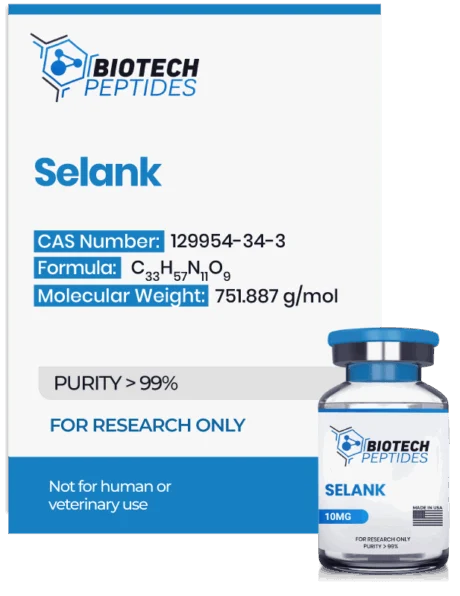
Selank (10mg)
$40.00
selank peptide, selank peptide benefits, selank peptides, selank peptide dosage, selank peptide dosage chart, selank peptide reddit,
what is selank peptide, what is selank peptide used for, peptide strength protocol benefits table selank,
Selank Peptides: A Comprehensive Research Guide
Selank peptides have emerged as a significant area of interest in neurobiological and immunological research. Selank is a synthetic heptapeptide composed of seven amino acids with the sequence Thr-Lys-Pro-Arg-Pro-Gly-Pro (TKPRPGP). This peptide is the synthetic equivalent of the naturally occurring immunomodulatory peptide tuftsin, which is derived from the human immunoglobulin G heavy chain. Selank peptides were developed at the Institute of Molecular Genetics in cooperation with the V.V. Zakusov Research Institute of Pharmacology of the Russian Academy of Medical Sciences. This comprehensive guide provides researchers with essential information about selank peptides, including their chemical properties, mechanism of action, research applications, and quality considerations.
Understanding Selank Peptides
Selank peptides are synthetic regulatory peptides belonging to the class of heptapeptides. The chemical properties of selank peptides include a molecular formula of C₃₃H₅₇N₁₁O₉ and a molecular weight of approximately 751.9 g/mol. Its CAS number is 129954-34-3.
Selank peptides are designed as a synthetic analog of the endogenous tuftsin molecule, which is the short Thr-Lys-Pro-Arg fragment of the human immunoglobulin G heavy chain. The peptide was elongated at the C-terminus via the addition of three natural L-amino acids (Pro-Gly-Pro) to improve its metabolic stability and yield a relatively longer duration of action. This modification enhances the peptide’s stability compared to the natural tuftsin molecule.
Selank peptides are typically supplied as a white to off-white lyophilized powder with purity specifications of at least 98% when analyzed by high-performance liquid chromatography. Proper storage of selank peptides at -20°C in a dry, desiccated environment protected from light is essential for maintaining peptide integrity. Upon reconstitution, the peptide should be stored at 4°C and used within a short timeframe to prevent loss of potency.
Mechanism of Action
GABAergic System Modulation
One of the best-characterized modes of action for selank peptides is their modulation of the GABAergic system. Research suggests that selank may alter the binding properties of gamma-aminobutyric acid (GABA) to its receptors, perhaps via allosteric modulation, thereby influencing inhibitory neurotransmission. It has been shown that selank affects [³H]GABA binding as a positive allosteric modulator.
The joint action of selank and some benzodiazepines also regulates the activity of [³H]GABA binding in a specific manner, which is not cumulative and differs from either substance individually. Selank has been shown to block the modulatory activity of diazepam and olanzapine, suggesting that the location of their binding sites and peptide binding sites are apparently not the same but may potentially partially overlap. This indicates that one of selank’s anti-anxiety molecular mechanisms may be associated with subtype-selective, concentration-dependent allosteric modulation of GABA receptors.
Enkephalin-Degrading Enzyme Inhibition
Selank peptides have been shown to inhibit enkephalin-degrading enzymes, which may be a possible mechanism for its anxiolytic activity. Examination of patients with various forms of anxiety and phobic disorders demonstrated a considerable shortening of enkephalin half-life and reduced total enkephalinase activity in the blood during generalized anxiety. This was probably related to low blood concentration of endogenous inhibitors of enkephalin-degrading enzymes in patients with generalized anxiety disorders.
Selank dose-dependently inhibited enzymatic hydrolysis of plasma enkephalin (IC50 15 microM). Selank was more potent than peptidase inhibitors bacitracin and puromycin in inhibiting enkephalinases. These results suggest that high efficiency of selank in the therapy of anxiety and phobic disorders may be due to its ability to inhibit enkephalin hydrolysis.
Immune and Cytokine Modulation
Selank peptides are connected with immunomodulation, including altering the expression of cytokines such as interleukin-6 (IL-6) and influencing the balance among T helper cell cytokines. Previous in vitro and in vivo experiments have confirmed that selank has immunomodulatory effects. For example, selank has antiviral activity against human influenza A/Aichi 2/68 virus (H3N2), human influenza B/Ohio 01/05 virus, and avian influenza A viruses.
The peptide’s immunomodulatory properties have been demonstrated through its ability to influence cytokine production and immune cell function. Selank peptides can modulate the expression of various cytokines, contributing to the regulation of immune responses. This immunomodulatory activity, combined with its effects on the GABAergic system, positions selank peptides as a unique compound with dual neuroactive and immunomodulatory properties.
Gene Expression Modulation
Selank peptides have been shown to influence gene expression in neuronal and immune cells. The peptide’s effects on gene expression may underlie many of its observed biological activities, including its anti-anxiety and immunomodulatory effects. Research suggests that selank can modulate the expression of genes involved in neurotransmitter signaling, immune function, and cellular stress responses.
Research Applications
Anxiety and Stress Research
Selank peptides have been extensively investigated for their potential anxiolytic properties. Research has demonstrated that selank can reduce anxiety-like behaviors in various animal models. Studies have explored how selank influences stress responses, anxiety-related behaviors, and neuroendocrine function.
The peptide’s effects on the GABAergic system and enkephalin-degrading enzymes suggest that selank may have applications in research into anxiety disorders and stress-related conditions. Researchers have investigated how selank compares to traditional anxiolytics and how it may modulate stress responses through multiple mechanisms.
Cognitive Function Research
Selank peptides have been studied for their potential effects on cognitive function. Research suggests that selank may influence learning, memory, and cognitive performance. Studies have explored how the peptide affects neurotransmitter systems involved in cognitive function and how it may modulate cognitive processes.
Researchers have investigated the effects of selank on attention, memory consolidation, and cognitive flexibility in various experimental models. The peptide’s potential cognitive-enhancing properties, combined with its anxiolytic effects, position selank as a compound of interest for researchers studying the intersection of anxiety and cognitive function.
Immunomodulation and Infection Research
Selank peptides have been investigated for their immunomodulatory properties. Research has demonstrated that selank can influence immune function through multiple mechanisms. Studies have explored how selank affects cytokine production, immune cell activity, and antiviral responses.
The peptide’s antiviral activity against influenza viruses suggests that selank may have applications in research into viral infections and immune modulation. Researchers have investigated how selank influences the immune response to viral infections and how it may modulate immune function in various contexts.
Neuroprotection Research
Selank peptides have been investigated for their potential neuroprotective properties. Research suggests that selank may protect neurons from various forms of stress and injury. Studies have explored how selank influences oxidative stress markers, cellular protection mechanisms, and neuronal survival.
The peptide’s effects on the GABAergic system and its immunomodulatory properties may contribute to its neuroprotective effects. Researchers have investigated how selank modulates neuroinflammatory responses and supports neuronal health.
Quality Considerations for Research Peptides
Purity Standards
For those acquiring selank peptides for research purposes, quality standards are essential. Research-grade selank should demonstrate minimum purity specifications of at least 98% when analyzed by high-performance liquid chromatography. Many suppliers require a minimum 98% to 99% purity specification enforced at the batch level, with release contingent on verified analytical conformance. High-purity research peptides are critical for experimental reproducibility, as impurities from synthesis can confound experimental results.
Analytical Verification
When acquiring selank peptides, researchers should ensure the supplier provides comprehensive analytical documentation. The certificate of analysis should include identity confirmation by mass spectrometry, purity by HPLC, sequence confirmation, and appearance testing. Additional testing may include residual solvent analysis, water content, acetate content, peptide content, endotoxin testing, and microbial limit testing.
Documentation Requirements
Legitimate suppliers should offer batch-specific Certificates of Analysis containing HPLC chromatograms and mass spectrometry identity confirmation. Third-party lab accreditation and pre-purchase document access are indicators of reliable sourcing. Researchers should verify that these documents are available before completing any transaction.
Storage and Handling
Selank peptides are typically supplied as a lyophilized powder, which helps preserve peptide stability during storage and transportation. Researchers should store lyophilized selank at -20°C in a dry, desiccated environment protected from light. Upon reconstitution, the peptide should be stored at 4°C and used within a short timeframe to prevent loss of potency.
Regulatory Status and Legal Considerations
Selank peptides are classified as research-use-only products for laboratory investigations. These compounds are not approved for human use outside of clinical trials and are intended exclusively for in-vitro laboratory research. Researchers must ensure compliance with all applicable regulations regarding the acquisition, handling, and use of research peptides in their jurisdiction.
Conclusion
Selank peptides represent a compound of significant research interest across multiple scientific disciplines, from neurobiology and anxiety research to immunology and infection studies. The peptide’s unique mechanism of action, involving modulation of the GABAergic system, inhibition of enkephalin-degrading enzymes, and immunomodulatory effects, distinguishes it from other compounds and positions it as a valuable research tool for investigating the intersection of neurobiology and immunology.
For researchers acquiring selank peptides, understanding the compound’s chemical properties, quality requirements, and research applications is essential. High-purity research-grade selank, stored and handled properly, provides a valuable tool for investigating fundamental biological processes. When evaluating suppliers, researchers should prioritize those that provide comprehensive quality documentation, including HPLC purity verification and mass spectrometry confirmation, to ensure experimental reproducibility and scientific validity.
The research applications of continue to expand as understanding of their mechanisms and potential applications deepens. From anxiety and stress research to cognitive function, immunomodulation, and neuroprotection, selank remains a compound of significant interest for researchers committed to scientific discovery. As the field of peptide research advances, selank peptides will undoubtedly continue to contribute to our understanding of fundamental biological processes and potential research applications.
Related products
BIOTECH PEPTIDE
BIOTECH PEPTIDE
BIOTECH PEPTIDE
BIOTECH PEPTIDE

BIOTECH PEPTIDE
BIOTECH PEPTIDE
BIOTECH PEPTIDE
BIOTECH PEPTIDE