
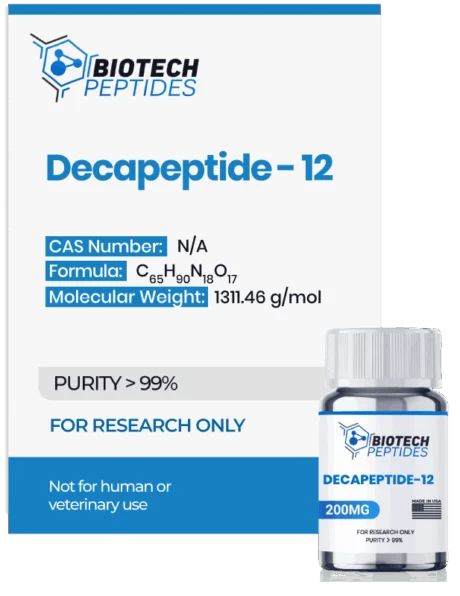
Decapeptide-12 (200mg)
$180.00
Decapeptide-12: A Comprehensive Research Guide
Decapeptide-12 has emerged as a significant compound of interest in dermatological and cosmetic research, particularly for investigations into melanogenesis, hyperpigmentation, and cellular senescence. Decapeptide-12 is a synthetic oligopeptide composed of ten amino acids with the sequence YRSRKYSSWY. This decapeptide functions as a potent and specific competitive inhibitor of tyrosinase, the key enzyme in the melanin biosynthesis pathway, making it a valuable research tool for studying skin pigmentation, aging, and inflammation.
Understanding Decapeptide-12
Decapeptide-12 is a small oligopeptide consisting of ten amino acids arranged in a specific linear sequence: H-Tyr-Arg-Ser-Arg-Lys-Tyr-Ser-Ser-Trp-Tyr-OH. The chemical properties of decapeptide-12 include a molecular formula of C₆₅H₉₀N₁₈O₁₇ and a molecular weight of approximately 1395.5 g/mol. Its CAS number is 137665-91-9.
The structure of decapeptide-12 is critical to its biological activity. The peptide’s specific amino acid sequence enables it to interact directly with the C-terminal residue of the tyrosinase enzyme with a dissociation constant (Kd) of 61.1 μM. This targeted interaction is what distinguishes decapeptide-12 from other skin-brightening compounds and makes it a precise biochemical tool for melanogenesis research.
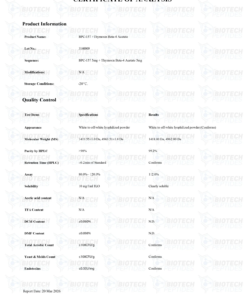
Decapeptide-12 is typically supplied as a lyophilized white powder with purity specifications of at least 95% to 98% when analyzed by high-performance liquid chromatography. Proper storage of decapeptide-12 at -20°C in a dry, desiccated environment protected from light is essential for maintaining peptide integrity. Researchers should prioritize suppliers that provide comprehensive analytical documentation, including Certificates of Analysis with HPLC chromatograms and mass spectrometry identity confirmation.
Mechanism of Action
Primary Biological Function: Tyrosinase Inhibition
The primary mechanism of action of decapeptide-12 is the competitive inhibition of tyrosinase, a copper-containing enzyme that catalyzes the rate-limiting steps in melanin synthesis. Tyrosinase is responsible for the hydroxylation of L-tyrosine to L-DOPA and the subsequent oxidation of L-DOPA to L-dopaquinone, both critical steps in the melanin biosynthesis pathway.
Decapeptide-12 acts as a competitive inhibitor of tyrosinase, meaning it binds to the active site of the enzyme and competes with the natural substrate, tyrosine. This competitive binding reduces the enzyme’s activity, leading to decreased melanin production. The peptide’s specific amino acid sequence enables it to interact directly with the C-terminal residue of the enzyme, providing targeted inhibition.
This mechanism makes decapeptide-12 distinct from other skin-brightening agents such as hydroquinone or kojic acid, which may have different modes of action or broader effects on cellular processes. The specificity of decapeptide-12 for tyrosinase positions it as a valuable research tool for investigators studying melanogenesis pathways.
Histone Deacetylase Inhibition
Recent research has revealed an additional mechanism of action for decapeptide-12: the inhibition of histone deacetylases. In a study utilizing a dual luciferase reporter assay, decapeptide-12 was found to activate the Tyrosinase promoter in an HDAC inhibitor-like manner, increasing the promoter activity by 1.45-fold . This is consistent with the known up-regulation of tyrosinase expression by HDAC inhibitors.
This dual mechanism—both inhibiting tyrosinase enzyme activity and influencing tyrosinase gene expression through HDAC inhibition—suggests that decapeptide-12 may have complex and multifaceted effects on melanogenesis. This finding adds another layer of interest for researchers studying the regulation of pigmentation at both the enzymatic and genetic levels.
Modulation of Senescence and Inflammation
Research has demonstrated that decapeptide-12 can modulate cellular senescence and inflammation in dermal fibroblasts. In a study of UVB-irradiated cells, decapeptide-12 treatment resulted in a significant reduction in senescence-associated beta-galactosidase staining, a marker of cellular aging. The peptide also reduced the secretion of the pro-inflammatory cytokine IL-6 by 29.2% and IL-8 by 25.7% in UVB-irradiated cells .
This dual activity—both tyrosinase inhibition and modulation of cellular senescence and inflammation—positions decapeptide-12 as a multifunctional research tool for investigating skin aging, pigmentation, and inflammatory responses.
Research Applications
Melanogenesis and Pigmentation Research
The primary research application of decapeptide is in the study of melanogenesis and pigmentation. Researchers investigating the molecular mechanisms underlying skin pigmentation, hyperpigmentation disorders, and melanocyte biology may find decapeptide-12 a valuable research tool. The peptide’s specific and competitive inhibition of tyrosinase allows researchers to study the enzyme’s role in melanin synthesis without the confounding effects associated with less specific inhibitors.
Studies have investigated the effects of decapeptide on melanin production in various in vitro models, including B16F10 murine melanoma cells. These investigations have contributed to understanding the regulation of melanogenesis and the potential applications of tyrosinase inhibitors in research contexts.
Anti-Aging and Cellular Senescence Research
Decapeptide-12 has been investigated for its potential to modulate cellular senescence and inflammation. In a study of UVB-irradiated human dermal fibroblasts, decapeptide-12 treatment resulted in significant reductions in senescence markers and pro-inflammatory cytokine secretion . These findings suggest that decapeptide-12 may have applications in research into skin aging, photoaging, and inflammatory skin conditions.
The ability of decapeptide-12 to modulate both pigmentation and cellular senescence makes it a compound of interest for researchers studying the interconnected processes of skin aging and pigmentation. The peptide’s effects on senescence-associated secretory phenotype markers suggest potential applications in research into age-related skin changes.
Cosmeceutical and Formulation Research
Decapeptide has been investigated for its potential applications in cosmeceutical formulations. Studies have explored the peptide’s stability, delivery, and efficacy in various formulation contexts. Research has examined how decapeptide-12 interacts with other ingredients and how its activity can be optimized in topical formulations.
The peptide’s safety profile has been evaluated in various in vitro and ex vivo models. These studies have contributed to understanding the potential applications of decapeptide in cosmeceutical research and development.
Combination Studies
Research has explored the potential of decapeptide in combination with other bioactive compounds. Studies have investigated whether the peptide’s tyrosinase inhibitory activity can be enhanced or modified by other ingredients. These combination studies contribute to understanding the potential applications of decapeptide-12 in multi-ingredient formulations for pigmentation and skin aging research.
Quality Considerations for Research Peptides
Purity Standards
For those acquiring decapeptide-12 for research purposes, quality standards are essential. Research-grade decapeptide-12 should demonstrate minimum purity specifications of at least 95% when analyzed by HPLC, with many suppliers offering products at 98% purity or higher. High-purity research peptides are critical for experimental reproducibility, as impurities from synthesis can confound experimental results.
Analytical Verification
When acquiring decapeptide, researchers should ensure the supplier provides comprehensive analytical documentation. The certificate of analysis should include identity confirmation by mass spectrometry, purity by HPLC, sequence confirmation, and appearance testing. Additional testing may include residual solvent analysis, water content, acetate content, peptide content, endotoxin testing, and microbial limit testing.
Documentation Requirements
Legitimate suppliers should offer batch-specific Certificates of Analysis containing HPLC chromatograms and mass spectrometry identity confirmation. Third-party lab accreditation and pre-purchase document access are indicators of reliable sourcing. Researchers should verify that these documents are available before completing any transaction.
Storage and Handling
Decapeptide is typically supplied as a lyophilized powder, which helps preserve peptide stability during storage and transportation. Researchers should store lyophilized decapeptide-12 at -20°C in a dry, desiccated environment protected from light. Upon reconstitution, the peptide should be stored at 4°C and used within a short timeframe to prevent loss of potency.
Regulatory Status and Legal Considerations
Decapeptide is classified as a research-use-only product for laboratory investigations. These compounds are not approved for human use outside of clinical trials and are intended exclusively for in-vitro laboratory research. Researchers must ensure compliance with all applicable regulations regarding the acquisition, handling, and use of research peptides in their jurisdiction.
The regulatory landscape for research peptides continues to evolve, and researchers should maintain awareness of relevant guidelines and requirements. Decapeptide remains an investigational compound not approved for therapeutic use.
Conclusion
Decapeptide-12 represents a compound of significant research interest across multiple scientific disciplines, from melanogenesis and pigmentation research to anti-aging and inflammation studies. Its unique dual mechanism of action—competitive tyrosinase inhibition and histone deacetylase inhibition—distinguishes it from other skin-brightening compounds and positions it as a valuable research tool for investigating pigmentation pathways and cellular senescence.
For researchers acquiring decapeptide, understanding the compound’s chemical properties, quality requirements, and research applications is essential. High-purity research-grade decapeptide, stored and handled properly, provides a valuable tool for investigating fundamental biological processes. When evaluating suppliers, researchers should prioritize those that provide comprehensive quality documentation, including HPLC purity verification and mass spectrometry confirmation, to ensure experimental reproducibility and scientific validity.
The research applications of decapeptide-12 continue to expand as understanding of melanogenesis and cellular aging deepens. From pigmentation research to anti-aging studies, decapeptide-12 remains a compound of significant interest for researchers committed to scientific discovery. As the field of peptide research advances, decapeptide will undoubtedly continue to contribute to our understanding of fundamental biological processes and potential research applications.
Related products
BIOTECH PEPTIDE
BIOTECH PEPTIDE
BIOTECH PEPTIDE
BIOTECH PEPTIDE
BIOTECH PEPTIDE
BIOTECH PEPTIDE
BIOTECH PEPTIDE
BIOTECH PEPTIDE