
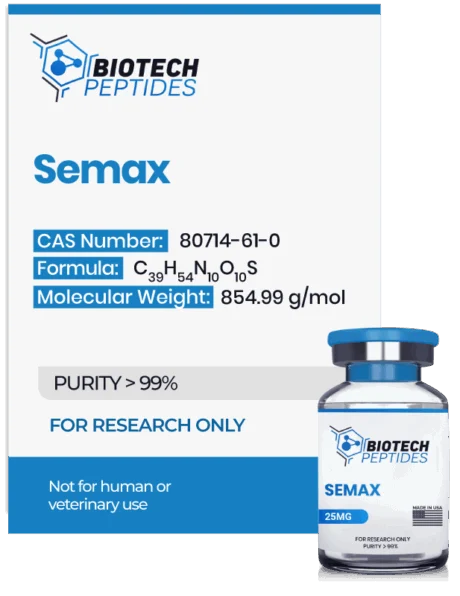
Semax (25mg)
$50.00
Buy Semax Peptide research grade. High purity neuroprotective compound. Bulk discounts available. Fast shipping. Secure checkout. Order now.
Semax Peptide: A Comprehensive Research Guide
Introduction to Semax Peptide
Semax peptide has emerged as a compound of significant interest in the field of neuroprotection and cognitive research. Originally developed as a synthetic analogue of adrenocorticotropic hormone (ACTH), Semax has attracted attention for its potential applications in studying brain function, neural recovery, and adaptive signaling pathways . This heptapeptide, composed of the amino acid sequence Met-Glu-His-Phe-Pro-Gly-Pro, represents a unique class of regulatory peptides that may influence information flow across neurochemical and molecular networks .
The peptide was designed as a nootropic and neuroprotective agent without hormonal activity or other side effects . Its structure incorporates the ACTH(4-7) fragment, with the tripeptide Pro-Gly-Pro (PGP) added to stabilize the C-terminus . This design has yielded a compound that researchers have investigated for its potential to support neurological function, stress-responsive pathways, and cellular resilience.
Chemical Structure and Properties
Semax peptide has a molecular formula of C₃₇H₅₁N₉O₁₀S and a molecular weight of 813.92 Daltons . The peptide is characterized by the presence of proline residues within its sequence, which are believed to contribute to structural stability and resistance to rapid enzymatic degradation in research environments .
The peptide is supplied as a lyophilized white to tan powder, with purity specifications typically exceeding 95% and often reaching 99% or higher for research-grade compounds . For laboratory applications, Semax peptide demonstrates solubility in organic solvents such as DMSO and dimethylformamide, as well as in aqueous buffers including PBS at pH 7.2, where solubility can reach approximately 10 mg/mL .
Proper storage conditions are essential for maintaining peptide integrity. Semax peptide should be stored at -20°C in a dry, sealed environment protected from light, where it can remain stable for at least two years . Upon reconstitution, researchers should use stock solutions promptly, ideally within one day, and avoid prolonged storage of aqueous solutions .
Mechanism of Action
Synactonal Mechanism
Research has proposed that Semax peptide operates through a synactonal mechanism of action . This hypothesis suggests that within the total pool of Semax metabolites, which include cleavage products of the parental molecule, a functional core can be distinguished . This core is represented by major metabolic products—the peptides HFPGP and PGP—which have their own binding sites with similar yet differing characteristics .
Together with Semax, these metabolites constitute a single complex of bioregulators that act in a specific sequence and in interaction, collectively termed a “synacton” . This mechanism suggests that Semax’s effects are not limited to a single molecular interaction but involve a coordinated cascade of regulatory activity.
Gene Expression Modulation
Research has demonstrated that Semax peptide significantly influences gene expression patterns in neural tissues. A 2020 study using RNA-Seq analysis identified 394 differentially expressed genes in the brains of rats at 24 hours after transient middle cerebral artery occlusion (tMCAO) treated with Semax compared to saline controls .
The peptide’s neuroprotective action appears to be associated with a compensation of mRNA expression patterns that are disrupted during ischemia-reperfusion conditions . Following tMCAO, Semax was found to suppress the expression of genes related to inflammatory processes while activating genes related to neurotransmission, effectively reversing the pattern induced by ischemia alone .
Neurotrophic Signaling
Research suggests Semax may influence transcriptional activity related to brain-derived neurotrophic factor (BDNF) and other growth-associated signaling molecules . Rather than initiating growth pathways directly, the peptide appears to contribute to the fine-tuning of transcriptional responsiveness within neural cells .
Investigations have also explored the peptide’s interaction with intracellular cascades linked to CREB (cAMP response element-binding protein), a transcription factor known to play a role in neural plasticity and memory-associated processes . Through this lens, Semax is positioned not as a stimulant of isolated outcomes but as a modulatory signal that may enhance or stabilize existing informational pathways .
Research Applications
Neuroprotection and Ischemic Stroke Research
Semax peptide has been extensively studied for its neuroprotective properties in the context of cerebral ischemia. Using the transient middle cerebral artery occlusion (tMCAO) model in rats, researchers have demonstrated that Semax improves animal survival after ischemic stroke and reduces the degree of neurological deficit .
A 2024 study revealed that Semax significantly reduced expression distortions caused by ischemia for 1171 genes associated with immune and neurosignaling pathways . The peptide’s effect on the transcriptome was found to vary with the time elapsed after tMCAO, with neurogenesis-, angiogenesis-, protein kinase-, and growth factor-related differentially expressed genes revealed under peptide action .
Histological studies have confirmed the neuroprotective effect of Semax at the tissue level, with the peptide inducing neuroglial cell proliferation and vascularization of brain tissues in perifocal zones at 24 hours after tMCAO .
Gene Expression Studies
A significant body of research has focused on Semax peptide’s effects on gene expression in distinct brain regions with varying degrees of ischemia injury. A 2025 study published in the International Journal of Molecular Sciences examined how Semax and another ACTH-like peptide affected gene expression in both the penumbra-associated region of the frontal cortex and the ischemia focus-containing striatum .
The findings revealed differential spatial regulation of the ischemia process at the transcriptome level. While peptides generated fewer differentially expressed genes in the striatum than in the frontal cortex, both peptides tended to normalize the profile of disturbances caused by ischemia for hundreds of differentially expressed genes . Approximately one hundred genes overlapped between the action of both peptides in both tissues and were associated with neuroactive ligand-receptor interaction .
Cognitive Signaling Research
Semax peptide has been examined for its potential relationship with cognitive signaling domains such as attention regulation, learning dynamics, and memory-associated processes . Research indicates that the peptide may influence synaptic communication efficiency, potentially by modulating neurotransmitter systems linked to glutamatergic and monoaminergic signaling .
The peptide is increasingly framed as a coordinator of informational flow, with hypotheses suggesting it may support the synchronization of signaling between cortical and subcortical regions, thereby influencing how information is processed, retained, and retrieved .
Stress-Responsive Pathways
Given its structural lineage from ACTH fragments, researchers have explored the possibility that Semax peptide may interact with neuroendocrine stress axes without engaging in classical hormonal outputs . Research suggests the peptide may influence stress-responsive gene expression patterns and neuromodulatory balance .
Rather than amplifying stress signals, Semax has been hypothesized to contribute to adaptive recalibration—supporting informational stability during periods of heightened signaling demand .
Neuroimmune Communication
Emerging research discourse considers Semax within the context of neuroimmune interaction. Investigations suggest the peptide may influence signaling molecules involved in inflammatory regulation, particularly cytokine-associated communication pathways . The peptide has been hypothesized to contribute to signaling balance—modulating how neural and immune systems exchange information—rather than suppressing or activating immune responses outright .
Quality Considerations for Research Peptides
Purity Standards
For research applications, Semax peptide should meet high purity standards. Industry guidance identifies at least 95% chromatographic purity as the analytical threshold for credible high-purity grade peptide products, with many suppliers offering compounds with 98% or 99% purity . Higher purity minimizes the presence of synthesis-related impurities, truncated sequences, or deletion products that could compromise experimental results.
Documentation Requirements
Reputable suppliers provide comprehensive documentation with each batch of Semax peptide. Certificates of Analysis should include HPLC purity verification, mass spectrometry confirmation of molecular weight, and batch-specific testing results . This documentation ensures experimental reproducibility and supports scientific validity.
Storage and Handling Protocols
Semax peptide should be handled with care to maintain compound integrity. Lyophilized peptide should be stored desiccated below -20°C, protected from light, in a dry and sealed environment . Upon reconstitution, aqueous solutions should be used promptly, and repeated freeze-thaw cycles should be prevented to avoid peptide degradation .
Emerging Research Trends
Transcriptomic Analysis
Ongoing research continues to explore Semax peptide’s effects at the transcriptome level. Studies have investigated the gene networks associated with the peptide’s action in rat brain regions with varying degrees of ischemia injury, identifying genes associated with neurotransmitter and inflammatory responses . These findings may be useful for selecting more effective neuroprotective drug structures in accordance with their specific tissue and therapeutic impact .
Spatial Regulation Studies
Recent research has revealed differential spatial regulation of the ischemia process in the rat brain at the transcriptome level under Semax peptide action . This finding underscores the complexity of the peptide’s effects and suggests that its neuroprotective properties may vary across different brain regions and types of tissue damage.
Time-Dependent Effects
Studies have demonstrated that the pattern of Semax peptide action on the transcriptome depends on the time elapsed after ischemic injury . This temporal dimension adds another layer of complexity to understanding the peptide’s mechanisms and has implications for the design of research protocols and potential therapeutic applications.
Conclusion
Semax peptide represents a compound of significant research interest across multiple scientific disciplines, from neuroprotection and ischemic stroke investigation to cognitive signaling and stress-responsive pathway research. Its unique mechanism of action, involving a synactonal complex of bioregulators, sets it apart from traditional peptide hormones and suggests a role as an informational modulator rather than a classical endocrine agent.
For researchers incorporating Semax into their work, understanding the compound’s chemical properties, mechanism of action, and current scientific literature is essential. High-purity research-grade Semax, stored and handled properly, provides a valuable tool for investigating fundamental biological processes and potential therapeutic interventions in neurological and cognitive research.
As the field advances, Semax will undoubtedly remain an important compound for scientific discovery. Researchers who prioritize quality documentation, appropriate handling protocols, and a thorough understanding of the current scientific literature position their investigations for meaningful contributions to the growing body of knowledge surrounding this remarkable peptide.
Related products
BIOTECH PEPTIDE
BIOTECH PEPTIDE
BIOTECH PEPTIDE
BIOTECH PEPTIDE
BIOTECH PEPTIDE
BIOTECH PEPTIDE

BIOTECH PEPTIDE
BIOTECH PEPTIDE