
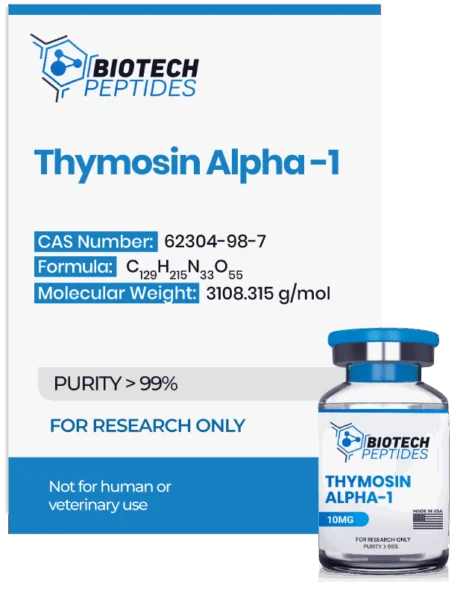
Thymosin Alpha-1 (10mg)
$110.00
Thymosin Alpha 1 Dosage guide covering standard protocols, loading doses, and research applications. Essential resource for researchers.
Thymosin Alpha 1 Dosage: A Comprehensive Research Guide
Thymosin alpha 1 is a synthetic acetylated polypeptide derived from the thymus gland that has garnered significant research interest for its immunomodulatory properties . Known commercially as thymalfasin (Zadaxin), this peptide primarily enhances cellular immunity with a well-established safety profile across multiple clinical applications . For researchers and clinicians seeking thymosin alpha 1 dosage information, this guide synthesizes data from clinical trials, approved protocols, and emerging research.
Standard Thymosin Alpha 1 Dosage Protocols
The most widely established thymosin alpha 1 dosage follows a consistent pattern across approved indications. The standard unit dose is 1.6 mg per injection, administered subcutaneously .
Chronic Hepatitis B Protocol Thymosin Alpha 1 Dosage
For chronic hepatitis B, the recommended thymosin alpha 1 dosage regimen is:
-
Dose: 1.6 mg per injection
-
Frequency: Twice weekly
-
Interval: 3-4 days between doses
-
Duration: 6 months (total of 52 injections)
-
Administration: Subcutaneous injection
Clinical trials have demonstrated that thymosin alpha 1 monotherapy at 1.6 mg achieves comparable efficacy to 0.8 mg dosing for various hepatitis B markers, with advanced fibrosis patients showing significantly better outcomes with the 1.6 mg dose at 24 weeks .
Vaccine Immune Response Enhancement Thymosin Alpha 1 Dosage
When used as an immunoadjuvant for vaccine response in immunocompromised patients:
-
Dose: 1.6 mg per injection
-
Frequency: Twice weekly
-
Interval: 3-4 days between doses
-
Duration: 4 weeks (total of 8 injections)
-
Administration: First dose immediately following vaccine administration
This thymosin alpha 1 dosage protocol is indicated for elderly patients, those on chronic hemodialysis, and other immunocompromised populations to enhance responses to influenza or hepatitis B vaccines .
Loading Dose Protocols in Cancer Immunotherapy Research
Recent clinical trials have explored personalized thymosin alpha 1 dosage approaches in combination with immunoradiotherapy regimens for advanced solid tumors. The PRaG 5.0 study (NCT05790447) introduced a stratified dosing strategy :
For Patients with Low Baseline T-Lymphocyte Counts
-
Loading Phase: 7-day loading dose protocol
-
Maintenance Phase: 1.6 mg thrice weekly following loading
For Patients with Normal T-Lymphocyte Counts
-
Maintenance Only: 1.6 mg thrice weekly
Among 39 treated patients in the PRaG 5.0 study, 30 required the loading dose protocol . Immune analysis revealed significant increases in CD8+ T cells, NK cells, and CD4+TEM cells following the thymosin alpha 1 loading dose, with notable decreases in Tregs .
Specialized Research Protocols Thymosin Alpha 1 Dosage
Depression in Common Variable Immunodeficiency
A proof-of-concept study investigating thymosin alpha 1 for depressive symptoms in CVID patients utilized a unique dosage schedule :
-
Week 1: 1.6 mg daily subcutaneously
-
Weeks 2-8: 1.6 mg twice weekly
-
Duration: 8 weeks total
All five treated patients showed a 52% average decrease in Hamilton Depression Rating Scale scores, with immune improvements including increased naïve/memory T cell ratios .
Sepsis Research
A Phase III trial for sepsis patients utilized a more intensive thymosin alpha 1 dosage:
-
Dose: 1.6 mg per injection
-
Frequency: Twice daily (BID)
-
Duration: 7 consecutive days
-
Administration: Subcutaneous
Preparation and Administration Thymosin Alpha 1 Dosage
Thymosin alpha 1 is supplied as a lyophilized powder in vials containing 1.6 mg of the active peptide . The standard preparation protocol requires:
-
Reconstitution with 1.0 mL of sterile water for injection
-
Dissolution immediately prior to use
-
Subcutaneous administration
-
Intramuscular injection is also noted as acceptable in some protocols
The peptide solution should be used promptly after reconstitution to maintain stability.
Important Research Considerations Thymosin Alpha 1 Dosage
Researchers should note that thymosin alpha 1 is classified as a non-reimbursable treatment in many healthcare systems, with off-label use common in oncology settings despite the approved indication being primarily for hepatitis B and vaccine immune enhancement . The peptide has demonstrated a favorable safety profile across studies, with no Grade 3 or above treatment-related adverse events reported in recent immunotherapy combination trials .
The efficacy of thymosin alpha 1 appears to be dose-dependent in certain contexts, with 1.6 mg showing advantages over 0.8 mg in advanced fibrosis patients, while both doses demonstrated comparable efficacy in broader hepatitis B cohorts .
Related products
BIOTECH PEPTIDE
BIOTECH PEPTIDE
BIOTECH PEPTIDE
BIOTECH PEPTIDE
BIOTECH PEPTIDE
BIOTECH PEPTIDE
BIOTECH PEPTIDE
BIOTECH PEPTIDE