
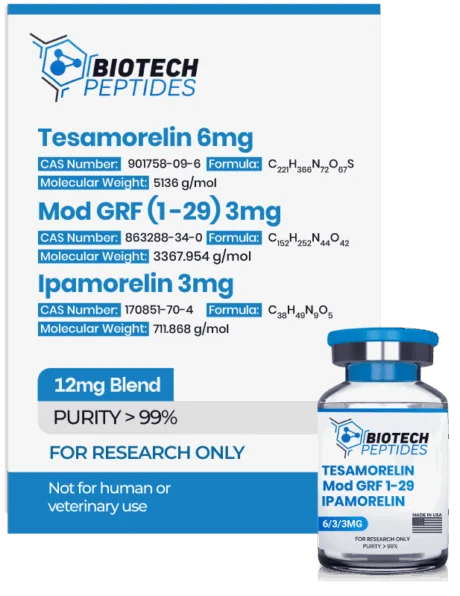
Tesamorelin & CJC-1295 (Mod GRF 1-29) & Ipamorelin Blend (12mg)
$90.00
Tesamorelin Ipamorelin Blend Dosage: Research protocols, administration schedules, and clinical guidelines. Evidence-based dosing. Learn more.
Tesamorelin Ipamorelin Blend Dosage: A Comprehensive Research Guide
The tesamorelin ipamorelin blend dosage is a subject of significant interest in peptide research, as this combination of two growth hormone (GH) secretagogues offers a unique approach to studying endocrine function and metabolic regulation. This guide synthesizes information from clinical protocols and research settings to provide a comprehensive overview of the tesamorelin ipamorelin blend dosage landscape.
Understanding the Tesamorelin Ipamorelin Blend
The tesamorelin ipamorelin blend combines two peptides with complementary mechanisms of action. Tesamorelin is a stabilized analog of growth hormone-releasing hormone (GHRH) that stimulates the pituitary gland to release growth hormone through the GHRH receptor pathway . Ipamorelin is a selective ghrelin receptor (GHS-R1a) agonist that acts on a parallel pathway on the same pituitary cells . When paired, this dual stimulation produces a larger, sharper pulse of growth hormone than either peptide alone .
Understanding the proper tesamorelin ipamorelin blend dosage is essential for researchers investigating metabolic processes, visceral fat reduction, and cellular regeneration. Tesamorelin has an FDA-approved version (Egrifta WR) for HIV-associated lipodystrophy, making it the only peptide clinically validated for visceral fat reduction . The combination with ipamorelin at research doses is used as an individualized protocol for investigational purposes .
Standard Tesamorelin Ipamorelin Blend Dosage Protocols
Various tesamorelin ipamorelin blend dosage protocols have been described in research and clinical settings. It is important to note that peptide protocols vary and should always be supervised by qualified professionals.
Common Blend Formulations
The tesamorelin ipamorelin blend is available in several formulations, with the most common being a combined vial containing specific ratios of each peptide. A standard blend might contain 10mg of tesamorelin and 5mg of ipamorelin . Some formulations include a third peptide, such as CJC-1295 no DAC, creating a 6mg/3mg/3mg tesamorelin/CJC-1295 no DAC/ipamorelin blend . Another variation is a triple blend containing 10mg tesamorelin, 5mg ipamorelin, and 10mg MOTS-c .
Reconstitution Guidelines
For a typical tesamorelin ipamorelin blend dosage protocol, reconstitution with bacteriostatic water is standard. For a 10mg tesamorelin and 5mg ipamorelin blend, adding 1mL of bacteriostatic water results in a concentration where 1mg tesamorelin equals 10 units and 0.5mg ipamorelin equals 10 units .
For a 6mg/3mg/3mg blend (tesamorelin/CJC-1295 no DAC/ipamorelin), reconstitution is generally performed with 1.5 to 2 mL of bacteriostatic water . This facilitates easy dosing calculations, with approximately 0.2 mL (20 units on an insulin syringe) providing around 200 mcg of each peptide per dose .
For a 12mg combined blend of tesamorelin, CJC-1295 (no DAC), and ipamorelin, adding 2mL of bacteriostatic water creates a concentration where 0.1 mL (10 units) provides a starting daily dose . Alternatively, adding 3 mL of bacteriostatic water to a 12mg vial results in a concentration of 400 mcg per 0.1 mL .
Standard Dosing Schedules
The most frequently cited tesamorelin ipamorelin blend dosage schedule follows a 5-day-on, 2-day-off protocol, with injections administered once daily, typically before bedtime . This schedule allows the body rest days and prevents desensitization .
Standard Protocol Option 1: Inject 1mg tesamorelin (10 units) + 0.5mg ipamorelin (10 units) subcutaneously daily, 5 days per week with 2 days off, for 60 to 90 days, followed by a 30-day break .
Standard Protocol Option 2: Inject 2mg tesamorelin (20 units) + 1mg ipamorelin (20 units) subcutaneously daily, 5 days per week with 2 days off, for 60 to 90 days, followed by a 30-day break .
Typical Starting Protocol: Begin with 200 mcg of the tesamorelin ipamorelin blend injected subcutaneously before bedtime for the initial week, allowing the system to adjust . If there are no side effects such as flushing or tingling, increase the dosage to 250–300 mcg each night .
Standard Clinical Protocol: Inject 20 units subcutaneously each night for 5 days in a row, followed by 2 days off . A typical cycle is 12 weeks on, then a 4-week break before repeating .
Titration and Adjustment Strategies
When determining the appropriate tesamorelin ipamorelin blend dosage, a conservative approach is often recommended. Beginning with a lower dose and gradually increasing over several weeks allows for monitoring of tolerance and helps minimize potential side effects .
Many individuals start at the lower dosage and gradually increase it every few weeks while monitoring for typical side effects such as slight water retention, increased appetite, or mild fatigue . Consistency in administration and adequate rest are considered more important than simply increasing dosages .
For those using a combined peptide blend, typical dosing ranges from 100 to 300 mcg based on individual objectives, tolerance, and medical advice . After two to three weeks, some protocols suggest dividing the dose into morning and evening injections to achieve enhanced metabolic outcomes .
Administration Guidelines
The tesamorelin ipamorelin blend dosage is administered via subcutaneous injection . The recommended injection site is the fatty region of the lower abdomen, approximately two inches from the navel . Injection sites should be alternated with each injection to prevent irritation; alternative sites include the outer thigh or the back of the upper arm .
Injections should be administered 30–60 minutes before bedtime to coincide with the body’s natural growth hormone cycle . It is recommended to avoid eating for 1–2 hours before dosing . Reconstituted peptides should be stored in the refrigerator .
Cycle Length and Maintenance
The typical tesamorelin ipamorelin blend dosage cycle follows specific patterns. A common approach involves using the blend for 4 to 6 weeks, followed by a break, allowing the body to adapt and minimizing the risk of potential side effects . Another protocol suggests a 12-week cycle, followed by a 4-week break before repeating .
The 5-on/2-off pattern gives the pituitary regular off-days, which is favored over continuous daily dosing . The 12-on/4-off cycle is designed to keep the GH axis responsive rather than driving it constantly, as sustained, non-pulsatile GH elevation represents a different physiologic state .
Safety Considerations
The tesamorelin ipamorelin blend dosage is generally considered well-tolerated when used appropriately under medical supervision. However, researchers should be aware of potential side effects, including slight water retention, increased appetite, or mild fatigue .
It is crucial to adhere to dosing guidelines to reduce risks . If any bloating, numbness, or joint stiffness occurs, individuals may consider pausing or reducing activity until these symptoms resolve . The cycle structure itself is the main lever for adjustment, with dose adjustments typically based on what the individual is noticing in sleep, training, and recovery .
Conclusion
The tesamorelin ipamorelin blend dosage represents a carefully calibrated approach to studying growth hormone dynamics through dual-pathway stimulation. Various protocols have been described, with the most common featuring a 5-day-on, 2-day-off schedule at doses ranging from 200 to 300 mcg per injection. Reconstitution volumes and concentrations vary depending on the specific blend formulation, making accurate calculation essential for research reproducibility. While existing research suggests promising applications, the tesamorelin ipamorelin blend dosage should only be used in controlled research settings under the supervision of qualified professionals.
Related products
BIOTECH PEPTIDE
BIOTECH PEPTIDE
BIOTECH PEPTIDE
BIOTECH PEPTIDE
BIOTECH PEPTIDE
BIOTECH PEPTIDE
BIOTECH PEPTIDE
BIOTECH PEPTIDE