
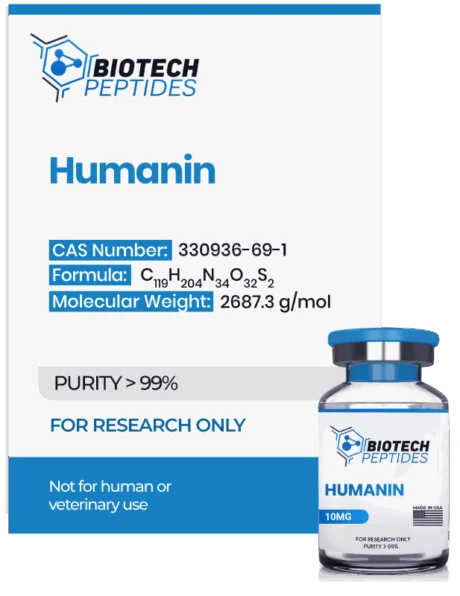
Humanin (10mg)

$110.00
Humanin Peptide: A Comprehensive Research Guide
Humanin peptide has emerged as one of the most intriguing discoveries in modern biomedical research, representing the first member of a novel class of mitochondrial-derived peptides (MDPs) that are encoded within small open reading frames in the mitochondrial genome . This 24-amino acid peptide was originally discovered in 2001 through a functional screening of a cDNA library created from the surviving fraction of an Alzheimer’s disease patient brain . Since its discovery, humanin peptide has been shown to possess remarkable neuroprotective, cytoprotective, anti-inflammatory, and anti-apoptotic properties, making it a subject of significant research interest across multiple scientific disciplines .
Understanding Humanin Peptide’s Origins and Structure
Humanin is a polypeptide that is highly conserved across species, suggesting its biological importance throughout evolution . The peptide is encoded by the MT-RNR2 gene within the 16S ribosomal RNA region of mitochondrial DNA . This is particularly significant because prior to humanin’s discovery, the mitochondrial genome was thought to only encode 13 proteins that all remain inside the mitochondria . Humanin shattered this paradigm, demonstrating that the mitochondrial genome can produce signaling molecules that function outside the organelle.
The humanin sequence can vary in length depending on whether the mRNA is translated in the cytoplasm or mitochondria. When translated using the cytoplasmic code, peptide is a 24-amino acid peptide, whereas translation using the mitochondrial code yields a 21-amino acid peptide . Both synthesized forms of peptide have demonstrated anti-apoptotic effects . The peptide contains what has been proposed to be a “pseudo-signal peptide,” enabling its secretion from cells, and it has been detected in cell culture medium as well as in plasma and various tissues .
Mechanisms of Action and Receptor Interactions
Humanin peptide exerts its biological effects through multiple mechanisms and receptor systems. Research has identified that humanin peptide acts as a ligand to two different types of receptors: the seven-transmembrane G protein-coupled receptor formyl-peptide receptor-like-1 (FPRL1) and a trimeric receptor consisting of ciliary neurotrophic factor receptor (CNTFR), the cytokine receptor WSX-1, and the transmembrane glycoprotein gp130 .
The first humanin peptide receptor to be described was FPRL1, which has been linked to Alzheimer’s disease research . In neuroblasts, both the 42 amino acid form of the β-amyloid peptide (Aβ42) and humanin peptide were able to activate FPRL1, but only Aβ42 was cytotoxic, and this cytotoxicity was reversed by humanin peptide . This suggests that the neuroprotective effects of humanin peptide might be accomplished by competitively binding to FPRL1 . Humanin peptide acts as an agonist for FPRL1 by inducing calcium mobilization and rapid activation of ERK1/2 signaling, a commonly induced downstream pathway of G protein-coupled receptors that may contribute to its cytoprotective aspects .
The second reported humanin receptor is the trimeric CNTFR/WSX-1/gp130 complex . Humanin peptide has been shown to induce STAT3 activation, which is required for its neuroprotective effects . Through this receptor complex, humanin peptide promotes the hetero-oligomerization of CNTFR, WSX-1, and gp130, initiating downstream signaling pathways mediated by Janus kinase (JAK)/STAT and ERK1/2 .
Intracellularly, humanin also interacts with several key proteins to inhibit apoptosis. Humanin peptide binds to the pro-apoptotic protein Bax, preventing Bax translocation to the mitochondria and thus blocking the initiation of cell death signals . Additionally, humanin peptide binds to insulin-like growth factor-binding protein 3 (IGFBP-3), and this interaction appears to interfere with IGFBP-3 dependent cell death .
Neuroprotective and Cytoprotective Properties
Humanin peptide was initially discovered for its neuroprotective effects, and extensive research has since confirmed its protective role across multiple disease models . In the context of Alzheimer’s disease research, humanin peptide has been shown to protect neurons from the toxic effects of amyloid beta (Aβ) and other Alzheimer’s disease-associated insults . Humanin peptide improves hippocampal acetylcholine and attenuates the development of oxidative stress and associated neurotoxicity, positioning it as a significant molecule in neurodegenerative disease research .
The neuroprotective action of humanin peptide extends beyond Alzheimer’s disease models. Research has demonstrated beneficial effects in experimental models of stroke, cardiovascular disease, and other neurological conditions . The peptide’s protective repertoire has rapidly expanded to various types of stress and disease models, with oxidative stress emerging as a common denominator across many of these conditions .
Interestingly, humanin peptide levels decline with age, which is a major risk factor for many diseases in which the peptide is protective, including Alzheimer’s disease, atherosclerosis, myocardial and cerebral ischemia, and type 2 diabetes . This age-related decline suggests that humanin peptide may play a role in the aging process itself, and that its reduced levels with age may contribute to increased susceptibility to age-related diseases .
Emerging Research in Metabolic Health
Recent research has significantly expanded the understanding of humanin role in metabolic health. Humanin peptide has been identified as a new player in the regulation of the growth hormone-IGF axis . It has been shown to decrease circulating IGF-I levels in mouse studies, having a diet-restriction-mimetic effect . This interaction is mediated through humanin peptide’s binding to IGFBP-3, which influences both IGF-I and humanin bioavailability .
Humanin peptide has also been investigated for its potential role in regulating autophagy pathways for therapeutic application in metabolic disorders . Autophagy is a self-eating cellular process in which the cell breaks down worn-out organelles, damaged proteins, and toxins . Impaired autophagy is a significant factor in the development of various metabolic disorders, along with oxidative stress and inflammation . Research indicates that humanin is an autophagy inducer that can promote cell survival in the presence of metabolic and oxidative stress .
Research on Humanin Peptide Analogues
Given the therapeutic potential of humanin, researchers have developed various analogues with enhanced potency. Among these, humanin-glycine (HNG) is the most widely studied analog in both in vivo and in vitro disease models . HNG is far more potent than the native humanin, with a potency that is 1000 times greater . This enhanced potency makes HNG a particularly valuable tool for research applications and for investigating the therapeutic potential of humanin analogues.
Recent research has demonstrated that HNG can attenuate dexamethasone-induced atrophy in human skeletal muscle cells, suggesting potential applications in muscle wasting research . In a study using primary human myotubes, co-treatment with HNG preserved myotube area and blunted dexamethasone-induced STAT3 activation compared to dexamethasone alone .
Evolution and Conservation of Humanin Peptide
Humanin has been the subject of evolutionary studies that have examined its conservation across species . Analysis of synonymous codon bias in humanin peptide coding sequences has demonstrated strong evidence of natural selection, indicating that the peptide has important biological functions that have been preserved throughout evolution . Two regions of highly conserved or invariant amino acids have been identified in the humanin peptide sequence, suggesting that these amino acids are critical for the peptide’s function .
Additional mitochondrial-derived peptides have been identified, including the six small humanin-like peptides (SHLP1-SHLP6) and MOTS-c, all encoded by sequences within the mitochondrial 12S and 16S ribosomal genes . Like humanin, these peptides have various effects in cell culture and animal models, affecting neuroprotection, insulin sensitivity, and apoptosis, with some being secreted and potentially having extracellular signaling roles .
Conclusion Humanin
Humanin represents a groundbreaking discovery in the field of mitochondrial biology, demonstrating that the mitochondrial genome encodes signaling peptides that function outside the organelle. From its initial identification as a neuroprotective factor against Alzheimer’s disease-related insults, humanin peptide has rapidly expanded its protective repertoire to encompass a diverse range of disease models and biological processes.
The peptide’s multiple mechanisms of action, including interactions with cell-surface receptors, intracellular protein binding partners, and its role in regulating autophagy and the growth hormone-IGF axis, position humanin as a significant research tool for investigating fundamental biological processes. The age-related decline in humanin peptide levels and its emergence as a regulator of metabolism further underscore its potential relevance in aging research and metabolic health studies.
For researchers, understanding the chemical properties, mechanisms of action, and current scientific literature on humanin is essential for designing rigorous investigations. The development of potent analogues such as HNG, which demonstrates 1000 times greater potency than the native peptide, offers exciting opportunities for research applications. As the field of mitochondrial-derived peptides continues to emerge, humanin will undoubtedly remain at the forefront of scientific discovery, offering insights into mitochondrial regulation of cellular activity and potential applications across a wide spectrum of human diseases.
Related products
BIOTECH PEPTIDE
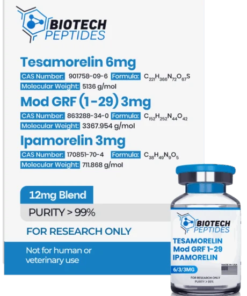
Tesamorelin & CJC-1295 (Mod GRF 1-29) & Ipamorelin Blend (12mg)
BIOTECH PEPTIDE
BIOTECH PEPTIDE
BIOTECH PEPTIDE
BIOTECH PEPTIDE
BIOTECH PEPTIDE
BIOTECH PEPTIDE
BIOTECH PEPTIDE